

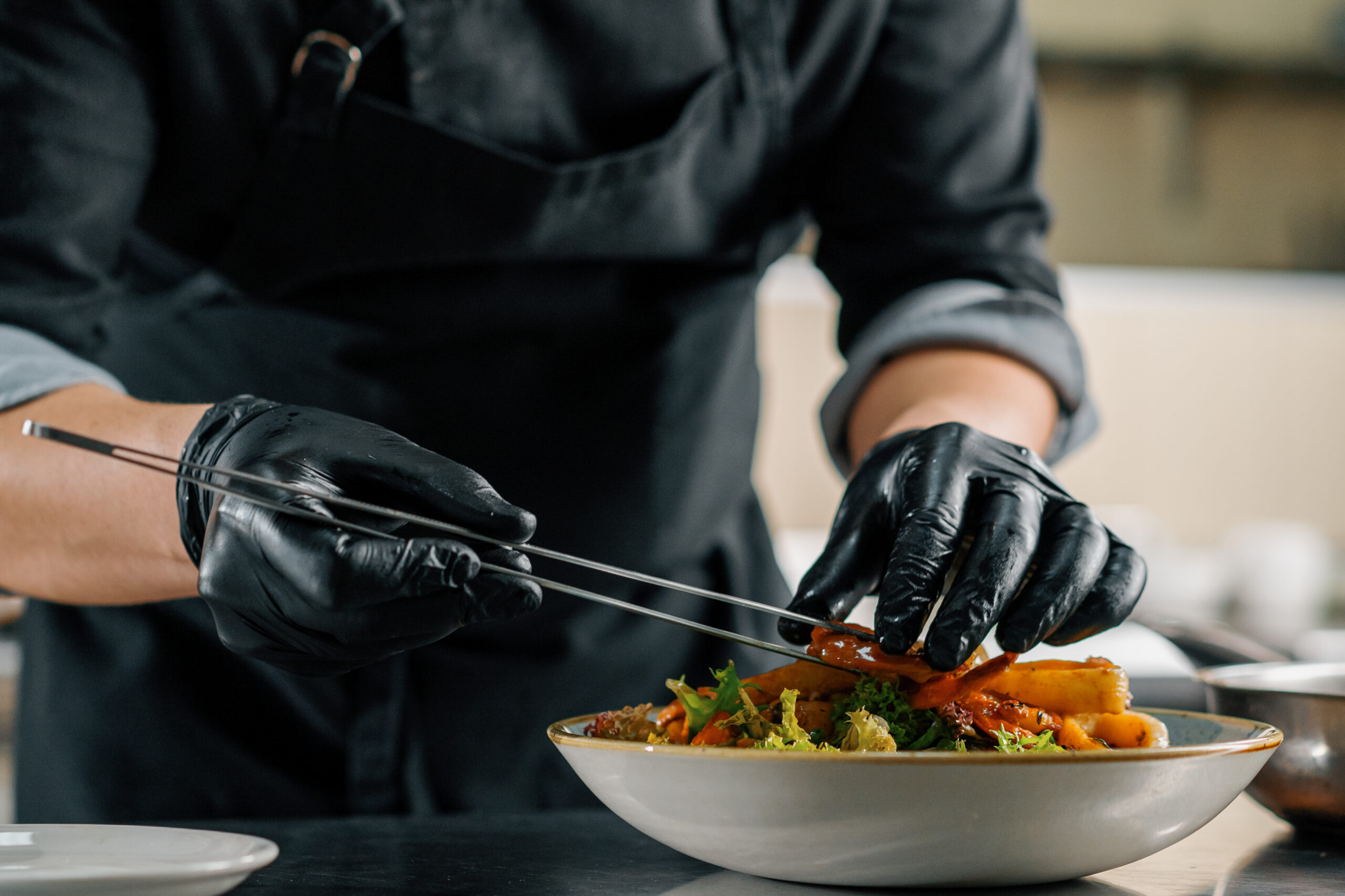

A private chef in Tunisia costs 80 to 200 dinars per guest — roughly €24 to €60 — with ingredients included. The chef shops that morning, cooks in your villa, serves, and leaves the kitchen clean. Book 24 to 48 hours ahead. For comparable quality, that is two to four times less than Western Europe.
How the evening actually runs
Five steps, almost always in this order.
- The brief. Headcount, date, service time, constraints — allergies, children, no pork, no alcohol, vegetarian. The chef comes back with two or three menus.
- The market run. The chef shops that morning: fish at the port, vegetables at the souk, bread from the neighbourhood bakery. This is where 70% of the result is decided, and why a local chef beats an imported one.
- Setup. Two to three hours before service for a standard dinner, longer for couscous or a whole roast lamb. The chef brings what the villa lacks — knives, serving dishes, sometimes tableware.
- Service. Plated or family-style, your call. One chef comfortably handles up to 10 guests; beyond that, expect a commis or server.
- Clean-up. Kitchen wiped down, bins out, dishes done. Meant to be included — confirm it, because it is not universal.
At The Landlord, the private chef service covers every managed property, from La Marsa to Djerba, with 24 to 48 hours’ notice recommended.
What a private chef in Tunisia costs in 2026
Ranges observed on the Tunisian market, alongside European equivalents. All figures are indicative, ingredients included unless noted.
| Format | Per guest (TND) | Approx. (€) | What you get |
|---|---|---|---|
| Simple lunch, 2 courses | 80 – 110 | 24 – 33 | Mechouia salad, grilled meat or catch of the day, fruit |
| 3-course dinner | 110 – 160 | 33 – 48 | Starter, signature main, homemade dessert |
| 4–5 course dinner | 160 – 250 | 48 – 75 | Tasting menu, premium fish, pastries |
| Celebration couscous | 120 – 180 | 36 – 54 | Generous single dish plus sides |
| Tunisian breakfast | 35 – 60 | 10 – 18 | Bsissa, ojja, msemen, fresh juice |
These ranges are orders of magnitude observed across the Tunisian market. They are not The Landlord’s rates and do not constitute a quote.
For context, at-home private chef work in France commonly runs €75 to €350 per person on specialist platforms, and international marketplaces list Tunis at roughly $180 to $250 per person — pricing aimed at an expatriate clientele rather than the local market.
The gap is not a quality gap. It comes down to three things: the cost of raw ingredients in Tunisia, the absence of a middleman when you book through a concierge that already contracts its chefs, and local labour costs. The fish comes off the same boat.
A useful benchmark: 150 TND per person for a dinner for six puts you at the top of the local range, with premium fish and pastry made that day.
What is included — and what is not
This is the single biggest source of misunderstanding. Check before confirming.
Usually included
- Shopping and ingredients
- Travel within a 20–30 km radius
- Table service
- Kitchen clean-up
Usually extra
- Alcohol — almost never included
- A dedicated server above 10 guests: budget 60 to 100 TND
- Rental of tableware, linen or furniture if the villa is short
- Special-order produce: lobster, bluefin tuna, desert truffle
- Long-distance travel (Djerba, Tozeur, Tabarka) if the chef is not based locally
Always ask for a written per-guest quote, all in, stating “ingredients, service and clean-up included”. Any serious operator will put that in writing.
What a Tunisian chef actually cooks
The tourist reflex is to ask for “an international menu”. That is almost always a mistake — the value of a chef in Tunis or Hammamet lies precisely in what you cannot get anywhere else.
| Register | Typical dishes | Best for |
|---|---|---|
| Classic Tunisian | Fish couscous, Tunisian tajine (closer to a baked frittata than the Moroccan dish), mloukhia, ojja with merguez | First-timers, groups, families |
| Fish & seafood | Whole baked sea bream or sea bass, grilled octopus, stuffed squid, Sfax-style complet poisson | Coastal stays: La Marsa, Hammamet, Djerba |
| Mediterranean | Grills, olive-oil roasted vegetables, seasonal salads | Longer stays, lighter appetites |
| Celebration / whole roast | Whole lamb or shoulder, semolina, mechouia and omek houria salads | Groups of 10+, birthdays |
| Tunisian pastry | Baklawa, kaak warka, samsa, makroudh, zlabia | Menu extension, late-evening tea |
One combination that almost never fails for a first dinner: a spread of Tunisian mezze to start, whole baked fish as the main, pastries and pine-nut tea to finish. It shows the cuisine, it shares well, and children eat it.
The three ingredients that make the difference
Not local colour — the concrete reasons a villa dinner in Tunisia is good.
Olive oil. Tunisia has settled into second place worldwide among producers for the 2025/26 season, with output estimated between 380,000 and 450,000 tonnes depending on the source, and 27.9% of global exports in the 2024/25 season. A local chef cooks with oil that would sell as a delicatessen product in Europe.
Harissa. Inscribed on the UNESCO Representative List of the Intangible Cultural Heritage of Humanity on 1 December 2022, under the title “harissa, knowledge, skills and culinary and social practices”. A good chef brings their own, or their family’s — not an industrial tube.
Couscous. Inscribed by UNESCO in December 2020, in a joint nomination with Algeria, Morocco and Mauritania. The Tunisian version is recognisable by its red tomato-and-harissa broth, spicier than the Moroccan style, and by its fish garnishes — grouper, sea bream, mullet — along the coast.
Per the UNESCO Intergovernmental Committee decision adopted in Rabat in December 2022, harissa is “an integral part of domestic provisions and the daily culinary and food traditions of Tunisian society”, most often prepared by women in a family or neighbourhood setting.
When it is genuinely worth it
| Situation | Verdict | Why |
|---|---|---|
| Group of 8–15 in a villa | Yes, easily | Per-head cost drops, and no restaurant seats twelve without schedule constraints |
| Family with young children | Yes | No drive home, no curfew, children eat on their own clock |
| Birthday, proposal, engagement | Yes | The gain is atmosphere, not price |
| Corporate stay or offsite | Yes | A working dinner with zero restaurant logistics |
| Couple, one evening | Depends | Per-person rates are highest at two; compare against a good Gammarth restaurant |
| Two-night stay, packed itinerary | No | Not enough time to enjoy it — book an excursion instead |
Over a full week, the pattern we see most often: a chef dinner on arrival night — nobody wants to hunt for a restaurant after a flight — and a second mid-stay, usually the couscous.
Diets, allergies and children
Five points that come up every time:
- Allergies. Flag them at the brief, not on the day. Tree nuts are everywhere in Tunisian pastry, sesame runs through the mezze.
- Pork-free / halal. Standard in Tunisia; nothing to request.
- Vegetarian and vegan. Very doable — Tunisian cooking is vegetable-heavy — but say so, or the default menu will be meat or fish.
- Children. Ask for a simple separate plate: pasta, grilled chicken, hand-cut chips. A chef who refuses is the wrong chef.
- Alcohol. You buy it yourself. The chef can suggest pairings, but alcohol sales are regulated and fall outside the service.
Booking and lead times
24 to 48 hours is enough for a standard dinner. Move to 5 to 7 days for peak season (July–August), groups over twelve, or a celebration menu with special-order produce.
What the chef needs, in order:
- Exact address and access details (gate, floor, parking)
- Exact headcount, adults and children listed separately
- Desired service time
- Dietary constraints
- Kitchen equipment: oven, number of burners, fridge size, outdoor plancha or barbecue
- How many place settings the villa actually has
That last point surprises people, and it is the one that most often causes trouble: a villa that sleeps ten does not necessarily own ten bowls. Booking through a concierge service removes the guesswork — the kitchen inventory is already known.
Private chef vs. restaurant: the real maths
For eight people, one dinner, greater Tunis, indicative 2026 figures:
| Line item | Private chef in villa | Good restaurant |
|---|---|---|
| Food | 8 × 140 TND = 1,120 TND | 8 × 110 TND = 880 TND |
| Drinks | Bought direct ≈ 150 TND | ≈ 320 TND (list markup) |
| Transport both ways | 0 | Two taxis or rides ≈ 120 TND |
| Childcare | 0 | 60 – 100 TND if applicable |
| Total | ≈ 1,270 TND | ≈ 1,380 TND |
From six to eight guests upward the comparison flips in favour of the private chef — and you book no table, drive nowhere, and watch no clock. Below four guests, the restaurant usually still wins on cost.
Five mistakes to avoid
- Booking before seeing the kitchen. Two burners and no oven seriously narrows the menu. Send a photo with your brief.
- Serving at 9pm in August. Heat destroys cold starters and pastry. In summer: 8pm outdoors, or inside with air conditioning.
- Asking for a European menu. You are paying a Tunisian chef to do a worse version of your usual Italian restaurant.
- Forgetting the villa staff. If a caretaker or housekeeper is on site, brief them: kitchen access, waste, hours.
- Not agreeing an end time. Otherwise the chef either disappears mid-dessert or waits around for nothing.
FAQ — private chef in Tunisia
Should I tip the chef?
Not compulsory, and not built into the rate. Local practice sits around 10% if you enjoyed the meal, handed over directly at the end of service.
Can the chef come several days running?
Yes, and that is where negotiated rates appear. On a week-long stay with daily service, a 10–20% discount on the unit price is common. Some families book the chef for lunches only and go out in the evenings.
Does it work in an apartment?
Yes, provided there is an oven and a table that seats everyone. Apartments in Berges du Lac, La Marsa or Sousse work well; under six guests, the logistics are actually simpler than in a villa.
Can the chef cook outdoors, by the pool?
That is the preferred setup from April to October. You need a plancha, a barbecue or an outdoor power point. Tell the chef in advance — the outdoor menu is not the indoor menu.
Does the chef speak English?
French is standard among professional Tunisian chefs. English varies more, so flag it at booking if your group is English-speaking; a concierge will then assign a chef accordingly.
Can I combine the chef with other services?
That is the norm. An airport transfer on arrival, a chef dinner that evening, then a private excursion the next day with a car and driver — that is the most requested combination on week-long stays.
In short
A private chef in Tunisia costs 80 to 200 TND per guest, books 24 to 48 hours ahead, and beats a restaurant on cost from six to eight people up. The raw ingredients — olive oil, fish, harissa — are the real argument. Ask for an all-in per-person quote, send a photo of the kitchen, and let the chef propose a Tunisian menu.
Looking for the villa to match? Our houses with summer kitchens and large outdoor tables in Gammarth, Hammamet and Sousse are built for this. The private chef service is arranged from your booking — see also things to do in Gammarth and where to stay in Tunis.
Sources
- UNESCO — Representative List of the Intangible Cultural Heritage of Humanity: “Harissa, knowledge, skills and culinary and social practices” (inscribed 1 December 2022, 17th Committee session, Rabat)
- UNESCO — “Knowledge, know-how and practices pertaining to the production and consumption of couscous” (inscribed December 2020 — Algeria, Morocco, Mauritania, Tunisia)
- Olive-sector data, 2025-2026 season — Tunisian olive oil production and exports (2nd worldwide; 27.9% of global exports in 2024/25)
- 2026 rate surveys across at-home chef platforms (France and international) — €75-350 and $180-250 per person
- The Landlord operational observations across the Tunisian managed portfolio (2019-2026)
Prices shown are indicative 2026 ranges and do not constitute a quote.